MoreExam
1. Question Content...
EXPLANATION
Answer: X - EXPLANATION Content.
Question1: You want to optimize the performance of an accurate, real-time, weather-charting application. The data comes from 50,000 sensors sending 10 readings a second, in the format of a timestamp and sensor reading.Where should you store the data?
Question2: Your company's user-feedback portal comprises a standard LAMP stack replicated across two zones. It is deployed in the us-central1 region and uses autoscaled managed instance groups on all layers, except the database. Currently, only a small group of select customers have access to the portal. The portal meets a99,99% availability SLA under these conditions. However next quarter, your company will be making the portal available to all users, including unauthenticated users. You need to develop a resiliency testing strategy to ensure the system maintains the SLA once they introduce additional user load.What should you do?
Question3: Your application needs to process credit card transactions. You want the smallest scope of Payment Card Industry (PCI) compliance without compromising the ability to analyze transactional data and trends relating to which payment methods are used.How should you design your architecture?
Question4: One of your primary business objectives is being able to trust the data stored in your application. You want to log all changes to the application data.How can you design your logging system to verify authenticity of your logs?
Question5: You are designing a large distributed application with 30 microservices. Each of your distributed microservices needs to connect to a database back-end. You want to store the credentials securely.Where should you store the credentials?
Question6: Your company just finished a rapid lift and shift to Google Compute Engine for your compute needs. You have another 9 months to design and deploy a more cloud-native solution. Specifically, you want a system that is no-ops and auto-scaling.Which two compute products should you choose? Choose 2 answers.
Question7: Your company's test suite is a custom C++ application that runs tests throughout each day on Linux virtual machines. The full test suite takes several hours to complete, running on a limited number of on-premises servers reserved for testing. Your company wants to move the testing infrastructure to the cloud, to reduce the amount of time it takes to fully test a change to the system, while changing the tests as little as possible.Which cloud infrastructure should you recommend?
Question8: You set up an autoscaling instance group to serve web traffic for an upcoming launch. After configuring the instance group as a backend service to an HTTP(S) load balancer, you notice that virtual machine (VM) instances are being terminated and re-launched every minute. The instances do not have a public IP address. You have verified the appropriate web response is coming from each instance using the curl command. You want to ensure the backend is configured correctly.What should you do?
Question9: You have been asked to select the storage system for the click-data of your company's large portfolio of websites. This data is streamed in from a custom website analytics package at a typical rate of 6,000 clicks per minute. With bursts of up to 8,500 clicks per second. It must have been stored for future analysis by your data science and user experience teams.Which storage infrastructure should you choose?
Question10: The application reliability team at your company this added a debug feature to their backend service to send all server events to Google Cloud Storage for eventual analysis. The event records are at least 50 KB and at most 15 MB and are expected to peak at 3,000 events per second. You want to minimize data loss.Which process should you implement?
Question11: Your customer is moving an existing corporate application to Google Cloud Platform from an on-premises data center. The business owners require minimal user disruption. There are strict security team requirements for storing passwords.What authentication strategy should they use?
Question12: Your solution is producing performance bugs in production that you did not see in staging and test environments. You want to adjust your test and deployment procedures to avoid this problem in the future.What should you do?
Question13: Your company runs several databases on a single MySQL instance. They need to take backups of a specific database at regular intervals. The backup activity needs to complete as quickly as possible and cannot be allowed to impact disk performance.How should you configure the storage?
Question14: A lead software engineer tells you that his new application design uses websockets and HTTP sessions that are not distributed across the web servers. You want to help him ensure his application will run properly on Google Cloud Platform.What should you do?
Question15: You want to make a copy of a production Linux virtual machine in the US-Central region. You want to manage and replace the copy easily if there are changes on the production virtual machine. You will deploy the copy as a new instance in a different project in the US-East region.What steps must you take?
Question16: You write a Python script to connect to Google BigQuery from a Google Compute Engine virtual machine.The script is printing errors that it cannot connect to BigQuery.What should you do to fix the script?
Question17: Your company wants to track whether someone is present in a meeting room reserved for a scheduled meeting. There are 1000 meeting rooms across 5 offices on 3 continents. Each room is equipped with a motion sensor that reports its status every second. The data from the motion detector includes only a sensor ID and several different discrete items of information. Analysts will use this data, together with information about account owners and office locations.Which database type should you use?
Question18: Auditors visit your teams every 12 months and ask to review all the Google Cloud Identity and Access Management (Cloud IAM) policy changes in the previous 12 months. You want to streamline and expedite the analysis and audit process.What should you do?
Question19: A production database virtual machine on Google Compute Engine has an ext4-formatted persistent disk for data files. The database is about to run out of storage space.How can you remediate the problem with the least amount of downtime?
Question20: You need to reduce the number of unplanned rollbacks of erroneous production deployments in your company's web hosting platform. Improvement to the QA/Test processes accomplished an 80% reduction.Which additional two approaches can you take to further reduce the rollbacks? Choose 2 answers.
Question21: Your company places a high value on being responsive and meeting customer needs quickly. Their primary business objectives are release speed and agility. You want to reduce the chance of security errors being accidentally introduced.Which two actions can you take? Choose 2 answers.
Question22: Your customer is moving their corporate applications to Google Cloud Platform. The security team wants detailed visibility of all projects in the organization. You provision the Google Cloud Resource Manager and set up yourself as the org admin.What Google Cloud Identity and Access Management (Cloud IAM) roles should you give to the security team?
Question23: Your company has decided to make a major revision of their API in order to create better experiences for their developers. They need to keep the old version of the API available and deployable, while allowing new customers and testers to try out the new API. They want to keep the same SSL and DNS records in place to serve both APIs.What should they do?
Question24: Your company is forecasting a sharp increase in the number and size of Apache Spark and Hadoop jobs being run on your local datacenter. You want to utilize the cloud to help you scale this upcoming demand with the least amount of operations work and code change.Which product should you use?
Question25: Your customer is receiving reports that their recently updated Google App Engine application is taking approximately 30 seconds to load for some of their users. This behavior was not reported before the update.What strategy should you take?
Question26: Your company has decided to build a backup replica of their on-premises user authentication PostgreSQL database on Google Cloud Platform. The database is 4 TB, and large updates are frequent. Replication requires private address space communication.Which networking approach should you use?
Question27: The database administration team has asked you to help them improve the performance of their new database server running on Google Compute Engine. The database is for importing and normalizing their performance statistics and is built with MySQL running on Debian Linux. They have an n1-standard-8 virtual machine with 80 GB of SSD persistent disk.What should they change to get better performance from this system?
Question28: You have created several pre-emptible Linux virtual machine instances using Google Compute Engine.You want to properly shut down your application before the virtual machines are preempted.What should you do?
Question29: Your marketing department wants to send out a promotional email campaign. The development team wants to minimize direct operation management. They project a wide range of possible customer responses, from 100 to 500,000 click-through per day. The link leads to a simple website that explains the promotion and collects user information and preferences.Which infrastructure should you recommend? Choose 2 answers.
Question30: Your company plans to migrate a multi-petabyte data set to the cloud. The data set must be available24hrs a day. Your business analysts have experience only with using a SQL interface.How should you store the data to optimize it for ease of analysis?
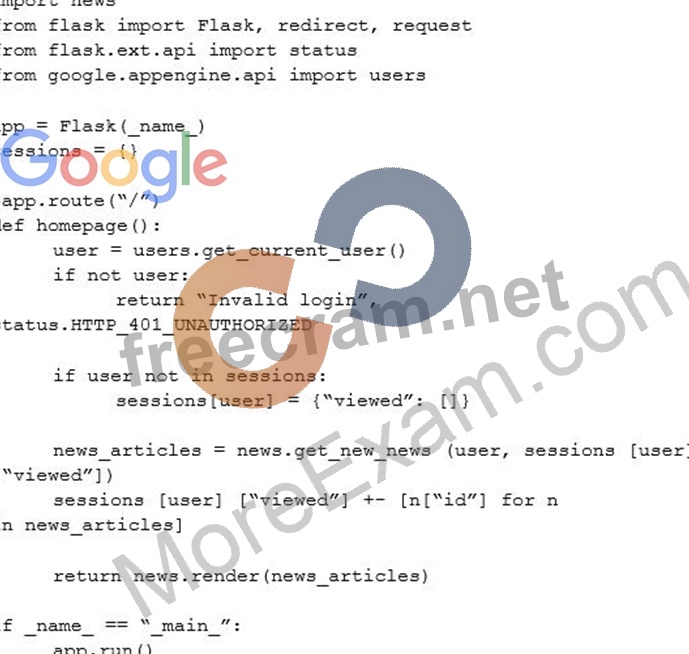
Question31: A news feed web service has the following code running on Google App Engine. During peak load, users report that they can see news articles they already viewed.What is the most likely cause of this problem?
Question32: During a high traffic portion of the day, one of your relational databases crashes, but the replica is never promoted to a master. You want to avoid this in the future.What should you do?
Question33: Your company has successfully migrated to the cloud and wants to analyze their data stream to optimize operations. They do not have any existing code for this analysis, so they are exploring all their options.These options include a mix of batch and stream processing, as they are running some hourly jobs and live-processing some data as it comes in.Which technology should they use for this?
Question34: A small number of API requests to your microservices-based application take a very long time. You know that each request to the API can traverse many services. You want to know which service takes the longest in those cases.What should you do?
Question35: Your company has successfully migrated to the cloud and wants to analyze their data stream to optimize operations. They do not have any existing code for this analysis, so they are exploring all their options.These options include a mix of batch and stream processing, as they are running some hourly jobs and live-processing some data as it comes in.Which technology should they use for this?
Question36: A recent audit revealed that a new network was created in your GCP project. In this network, a GCE instance has an SSH port open to the world. You want to discover this network's origin.What should you do?
Question37: A development manager is building a new application. He asks you to review his requirements and identify what cloud technologies he can use to meet them. The application must:Be based on open-source technology for cloud portabilityDynamically scale compute capacity based on demandSupport continuous software deliveryRun multiple segregated copies of the same application stackDeploy application bundles using dynamic templatesRoute network traffic to specific services based on URLWhich combination of technologies will meet all of his requirements?
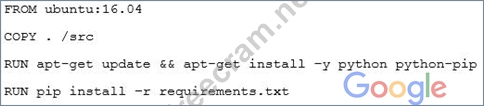
Question38: One of the developers on your team deployed their application in Google Container Engine with the Dockerfile below. They report that their application deployments are taking too long.You want to optimize this Dockerfile for faster deployment times without adversely affecting the app's functionality.Which two actions should you take? Choose 2 answers.
Question39: You want to enable your running Google Container Engine cluster to scale as demand for your application changes.What should you do?
Question40: Your company has successfully migrated to the cloud and wants to analyze their data stream to optimize operations. They do not have any existing code for this analysis, so they are exploring all their options.These options include a mix of batch and stream processing, as they are running some hourly jobs and live-processing some data as it comes in.Which technology should they use for this?
Question41: An application development team believes their current logging tool will not meet their needs for their new cloud-based product. They want a better tool to capture errors and help them analyze their historical log data. You want to help them find a solution that meets their needs.What should you do?